Blog
HR 101: Skills and Competencies
Skills are reshaping how organizations hire, develop, and mobilize talent, but what do we mean by ‘skills’? How do they differ from competencies, and how can they be measured reliably so you can start building a more agile, skills‑based workforce?
Share
Share
Why skills are suddenly everywhere
Skills have become the currency of the talent marketplace, because they describe what people can actually do today and what they can learn tomorrow. As job titles blur and careers become more fluid, employers need a more precise way to compare people and roles than CVs or job histories alone. The urgency is well documented: in one McKinsey survey, 58% of respondents said closing the skills gap at their company had become a priority.
A skills‑based approach helps organizations respond to talent shortages, automation, and digital transformation by focusing on capabilities rather than credentials. When you understand skills at scale, it becomes easier to redeploy people, design new roles, and give employees clearer pathways to grow.
What do we actually mean by “skills”?
In everyday language, “skills” often gets used loosely, but in talent decisions it helps to distinguish between behavioral skills and technical or functional skills, which together provide a fuller picture of performance.
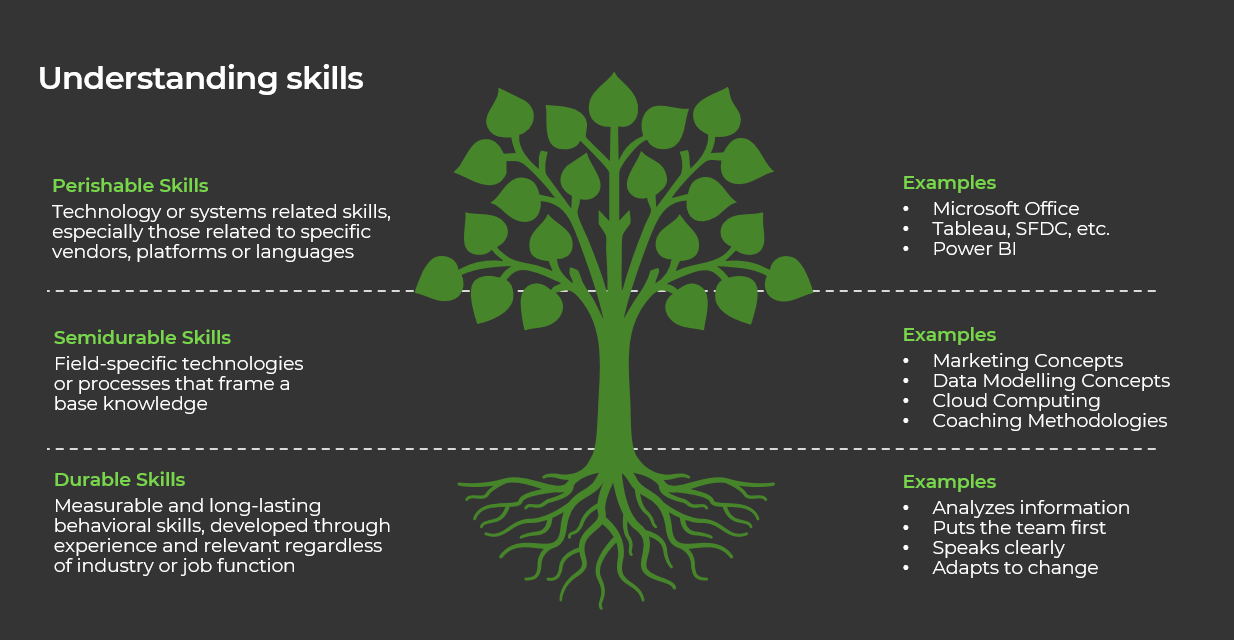
- Behavioral skills (sometimes called “soft skills”) describe how people approach work and interact with others, such as collaborating, adapting to change, or making decisions. These skills are durable and transferable across roles and industries, and they are key differentiators of performance.
- Technical/functional skills (often referred to as “hard skills”) cover job‑specific knowledge and proficiencies, such as using a particular software platform or operating a specific machine. Some are perishable and need frequent updating, especially where technology changes quickly.
SHL’s Global Skills Taxonomy organizes 96 universally relevant behavioral skills in simple, context‑free language, giving HR teams a standard way to describe and compare skills across roles, levels, and geographies.
Not All Skills Are Created Equal
Skills vs. competencies: how are they different?
Competencies (also sometimes known as ‘capabilities’) are sets of behaviors that are instrumental in the delivery of desired results (Bartram et al., 2002). Competencies offer broad descriptions of workplace effectiveness, helping organizations structure hiring, development, and performance management initiatives, for example ‘Decision Making’, or ‘Critical Thinking.’
However, competencies alone lack the granularity needed to pinpoint role-specific success factors. This is where skills play a crucial role. Skills are the behavioral “building blocks” that sit underneath those competencies, spelling out observable actions in much more detail. A single competency can be underpinned by different combinations of skills in different roles.
By mapping your existing competency model to skills, or using a validated framework like SHL’s Universal Competency Framework, the clarity and familiarity of competencies is maintained while adding the granularity needed for hiring, development, and mobility decisions.
How skills are measured
Not all skills data is equal. CV parsing, job history, or self‑reported skills on profiles can be quick to capture but are backward‑looking, subjective, and often inconsistent. They are also vulnerable to uneven self‑awareness, which limits their value for selection or promotion decisions.
Objective assessments, by contrast, use psychometrics to measure skills reliably and fairly, reducing response bias, providing a consistent skills “language” before and after hire, and generating data that can be used for both selection and development.
Once you have robust skills data, you can start to apply it across the employee lifecycle, not just at the point of hire. For example, skills profiles can be used to align job descriptions with real role requirements, design more predictive hiring assessments and interviews, and identify high‑potential talent for promotion or lateral moves. The same data can power more targeted onboarding and development by highlighting specific behavioral skills to strengthen, and it can support talent mobility by showing which employees have the skills or reskilling potential to move into emerging roles.
Where to start as an HR team
For HR leaders, the first step is to align clear definitions of skills and competencies in your organization and to connect them to existing frameworks and processes or use a validated framework like SHL’s Universal Competency Framework. From there, a few critical roles can be identified to pilot a robust, validated skills assessment to quickly surface insights about strengths, gaps, and internal mobility opportunities to start embedding skills data across the organization to drive talent strategy.
Learn more about how SHL’s Global Skills Assessment can provide a consistent, science‑based view of 96 behavioral skills across candidates and employees in just 15 minutes.
Author