Blog
Leading in an AI Age: People Leadership
As AI transforms the workplace, leaders need to inspire their teams to perform, spark innovation, communicate transparently, and foster growth. Here's how empathetic, inspiring leadership continues to set the best apart in an increasingly intelligent world.
Share
Share
Leading with humanity in the AI Era
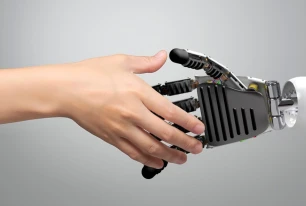
Technology now amplifies every dimension of business performance, but people remain the key differentiator. Leaders today need to evolve, harnessing that human element, motivating, developing, and connecting teams to strategic goals while using intelligent tools.
SHL’s AI Leadership Profile, validated using a dataset of more than 1,600 leaders across different industries, functions and regions, identifies four broad capabilities that define success in the AI era. Here we’ll focus on one of them: People Leadership.
Why people leaders are needed
57% of employees do not trust AI to understand human behavior in the workplace¹, highlighting the leader’s role in connecting with their teams and nurturing a culture where individuals feel valued. Interpersonal skills that AI cannot replicate, such as emotional awareness, empathy, and communication, are how people leaders can make a difference.
As workplaces adopt more advanced AI capabilities, the risk of dehumanization grows. It is the AI-ready leader who ensures that technology enhances, not erases, the human experience at work.
Core competencies that define People Leadership
Our research found two competencies that characterize People Leadership: ‘Inspires commitment’ and ‘develops & communicates.’
Inspires commitment
AI-ready leaders rally teams around a common vision. They provide context and empathy, spark optimism, and make others feel part of something bigger. Their ability to shape a culture of belonging keeps individuals not just engaged, but genuinely motivated.
About one-third of current leaders score in the high range on ‘inspires commitment’.
Leaders tended to score better on this competency than most of the other competencies analyzed in our research, although a quarter still needed significant immediate development.
Leaders who struggle here might focus heavily on logistics and overlook the emotional dimension of leadership. Developing this skill involves visible enthusiasm. Understanding what motivates different team members, being aware of how the human context should impact decisions and expressing optimism about the organization’s goals.
Develops & communicates
This competency is about fostering growth through ongoing feedback, clarity, and empowerment. AI-ready leaders guide their colleagues while encouraging autonomy, providing opportunities for them to learn from experience rather than micro-managing every step.
In contrast to ‘inspires commitment’, ‘develops & communicates’ was lacking in a high proportion of leaders. Only a quarter scored in the high range, while almost 40% needed significant immediate development. Even among senior executives and C-suite leaders who typically outperformed other management levels, one third were still found to need significant development in this area just to get up to an average level of potential.
Those leaders who do excel in this area are clear communicators who provide support and feedback, encourage continuous learning, and involve others in decision making.
Developing the human edge
To grow in the area of People Leadership, assessing the interpersonal skills of leaders and how they communicate, motivate, and delegate can help develop the right skills, tailor growth strategies and get a better picture of leadership potential.
Some suggestions for how to develop in this area include:
- Spark enthusiasm: Regularly share your vision in meetings, linking each person’s contribution to broader goals.
- Invite optimism: Seek input before making decisions, reflect others’ ideas in plans, and express hope about outcomes.
- Balance guidance and autonomy: Hand over responsibility gradually and resist over-managing.
- Build trust: Involve colleagues who often work outside your core circle to create diversity of thought that can strengthen collaboration.
The future belongs to human leaders
As AI redefines work, leadership that connects people to purpose will remain irreplaceable. AI-ready leaders bridge humanity and technology by ensuring that AI serves human progress, not the other way around.
To discover how to identify and develop your organization’s future people leaders, check out our latest webinar: AI-Ready Leaders: Driving Performance in an AI-Enabled World
¹Hougaard, Carter, & Stembridge (2024; HBR)
Author