HR’s Journey Toward Meaningful Transformation
HR priorities are constantly changing, and to keep pace, HR teams have had to rapidly develop new skills. But what skills have faded in importance, remain important, and will ensure future success?
Share
From crisis navigators to adaptive workforce architects
The HR toolkit has become more streamlined, emphasizing quality over quantity. While some enduring skills remain critical for HR professionals across time, new key skills have emerged and others have lessened in importance.
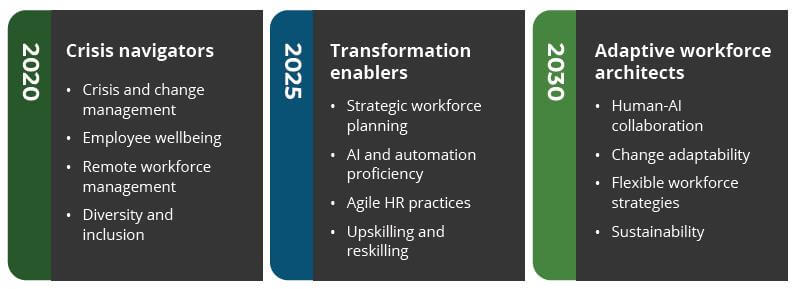
In 2020, the HR focus was on crisis navigation: managing change, supporting employee wellbeing, enabling remote work, and advancing diversity and inclusion. By 2025, the emphasis shifted to transforming the workforce through strategic planning, AI proficiency, agile HR practices, and ongoing upskilling.
Looking ahead to 2030, HR leaders will become adaptive workforce architects, driving skills transformation through human-AI collaboration, developing flexible workforce strategies, and championing sustainability. This shift signals a bold progression from reactive crisis management to proactive and innovative workforce design.
These advancements demonstrate an evolution from reactivity and urgent response toward proactivity, with HR looking ahead to preparing organizations for dynamic, tech-enabled futures and empowering people and businesses to thrive in new ways.
Skills fading away
Some individual skills that were once crucial for HR success, such as Writes with clarity, Speaks clearly, and Complies with rules and regulations, have taken a backseat since the pandemic. Why? In many cases, automation and technology have absorbed or streamlined these previously essential tasks. Routine documentation, policy checks, and even basic communication tasks can now be supported or partially handled by digital tools.
The widespread adoption of AI systems has also acted as an equalizer, meaning that AI can help fill gaps in areas where individuals may have previously differed significantly. Instead of relying solely on employees to know every policy detail, remember specific procedures, or produce consistently clear written communication, AI can now supply that missing knowledge or skill support. It can provide quick answers, draft or refine messaging, check for errors, and guide employees through complex processes. As a result, the performance gap between people who were naturally strong in these areas and those who were not has narrowed.
Because AI can compensate for these gaps, organizations are placing less emphasis on certain mechanical or knowledge-based skills and more emphasis on the strategic, interpersonal, and judgment-driven capabilities where humans still hold a clear advantage.
With an increasingly tech-savvy workforce, soon to be dominated by Gen Z, and data-driven decision-making taking the guesswork out of crucial decisions for modern organizations, other skills have emerged as true differentiators.
Skills that remain important
‘Manages conflict’ and ‘Supports and coaches others’ are two skills that came to the fore in the past year and will remain important through at least 2030, according to our research. These skills emphasize the centrality of teamwork within an HR team’s skills armory, both within the department and across other stakeholders in the business. As HR professionals become more agile in their roles, and are expected to be knowledgeable in talent acquisition, talent management, and skills development, supporting each other, sharing knowledge, and overcoming obstacles will be key to achieving success.
Interestingly, ‘Analyzes information,’ a skill that showed high importance in 2020 but was deprioritized in 2024, is expected to regain traction and become critical again by 2030. The abundance of talent data and resulting need for understanding of how and where it can provide value is one of many reasons for this. Despite the advent of AI automating some of the data process tasks, the ability to accurately judge the relevance of information and form actionable conclusions will be important.
Skills that will help future success
By 2030, a new skill will take center stage: ’Embraces new ideas.’ As industries embrace innovation, the abilities to think creatively and adapt quickly have become non-negotiable. Leaders, in particular, have a responsibility to encourage their teams to produce new ideas, experiment, and demonstrate enthusiasm for diverse, unconventional thinking that could help individual roles, team goals, or the wider business. Strength in this skill also provides confidence that HR teams can deal with the inevitable change that business transformation, emerging technologies, and industry and market changes bring, heavily impacting ways of working.
As HR continues their journey towards meaningful transformation, empowering employees to self-develop, encouraging a learning culture, and understanding which skills gaps need to be addressed will help teams maintain an engaged, dependable, and productive workforce.
See what the future of skills looks like for HR teams by downloading our HR Skills Insights research report.