Blog
Do Your Organizational Values Actually Mean Anything?
Every organization claims to have strong values, but how can leaders know if those values are truly embedded in the culture or just words on a website? Here’s how to move from wishful thinking to evidence-based confidence about values alignment.
Share

Share
Why making values meaningful is hard
Most organizations invest significant time and energy in defining their values. Yet, research consistently shows a gap between espoused values (what leaders say) and enacted values (what people actually do).
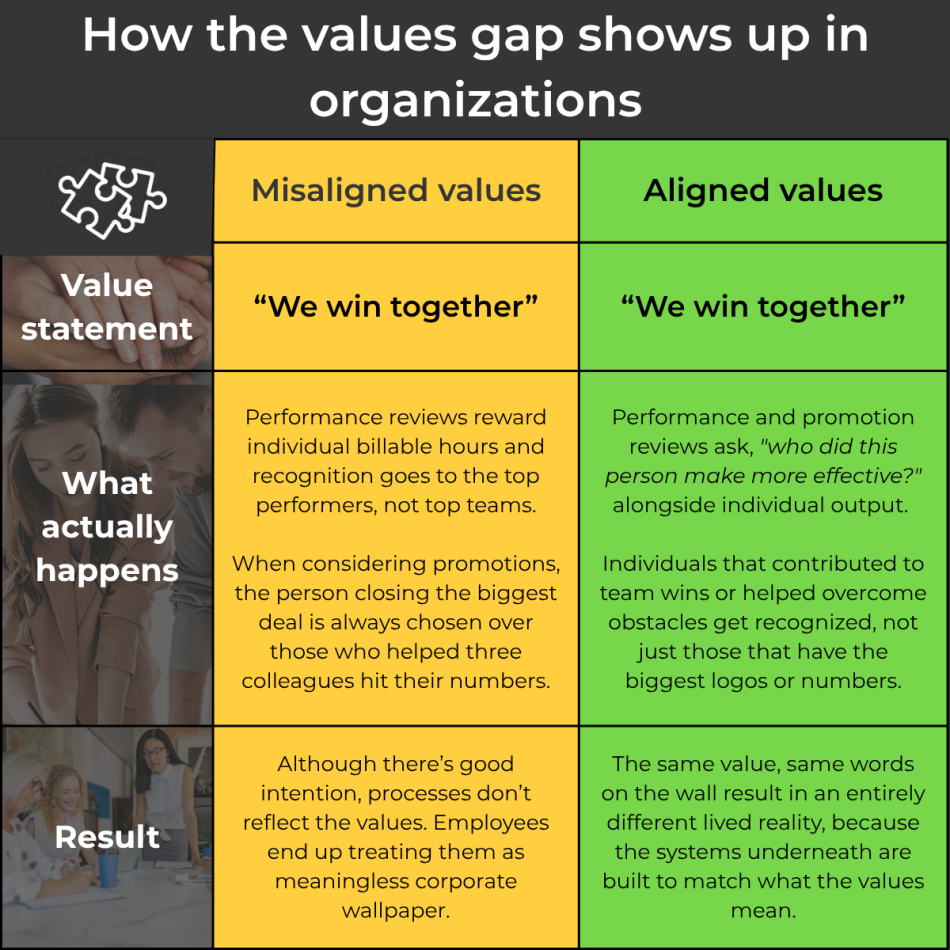
Values are often aspirational, sometimes performative, and occasionally descriptive. Problems arise when leaders fail to distinguish between these types or when the values on the wall don’t match the behaviors that are rewarded, promoted, or celebrated. The real challenge isn’t writing values statements, it’s ensuring those values are lived, rewarded, and sustainable.
Are your values reflected in your culture?
Employees rarely become emotionally attached to values statements themselves - what matters more are the shared purpose, meaningful work, trust in leaders, and the behaviors that get recognized.
The most useful way to assess an organization's values is to look beyond the official statements and ask questions like:
- What behaviors are rewarded?
- Who gets promoted?
- Do our people actually behave in ways that reflect our values?
- What stories are celebrated?
- How are difficult decisions made?
- What sacrifices is the organization willing to make?
- Where are the hidden gaps between what we say and what we do?
Culture is not what an organization says it values; culture is what people have to do to succeed there. When official values and lived values are closely aligned, values can be powerful, but when they diverge, they quickly are ignored. Often fact, there is often a direct correlation between this alignment and an individual’s job satisfaction.
Measuring demonstrated skills and preferences
To bridge the gap between espoused and enacted values, organizations need to find ways to measure both what people do and how they prefer to operate. This means translating values into observable behaviors and creating mechanisms to assess whether those behaviors are present and sustainable.
One evidence-based approach is to combine measures of the skills people actively demonstrate with insights into their preferred ways of working. For example:
Behavioral assessments can reveal the extent to which value-driven behaviors are actually present in the workforce.
Personality questionnaires can indicate whether employees’ natural preferences align with those values.
When both are present, high demonstration of values-driven behaviors and high preference for those behaviors, organizations can be confident that values are not only espoused but likely to be embedded and sustainable. If gaps exist, they highlight opportunities for leadership development, or process change.
From measurement to movement
Identifying gaps between espoused and enacted values isn't the end of the work, it's the starting point. Once you know where misalignment lives, the next step is deciding what you're willing to change: who you promote, what you reward, and which "difficult decisions" you're prepared to make differently next time.
Pick one value, not all of them. Start with whichever ties most directly to an outcome you already track and dig into that first.
Read the data together. Low demonstrated behavior plus high natural preference means the environment is suppressing the value, not that people lack it. That points to a systems or tools fix, not a training fix.
Close the loop. If employees flagged the gap, tell them what changed and what is being done. Surveys with no outcomes kill trust faster than no survey at all.
Measure regularly. Values drift as the organization grows and priorities change. A one-off audit is a good starting point but value alignment should be tracked regularly to stop misalignments creeping in.
The organizations that get the most from their values aren't the ones with the best-written statements. They're the ones willing to check the gap between the poster on the wall and last quarter's promotion, and act on what they find.
See how SHL can help bring objective data to understand your people better and drive aligned values that result in real cultural shift.
Author