Blog
Is Your Workforce Really AI-Ready, Or Just Using the Tools?
Employees everywhere are using AI, but only a minority are ready to turn it into real performance. Research shows there is a gap between readiness and adoption, here’s how HR can bridge that gap to unlock meaningful productivity gains.
Share
Share
AI adoption is high – readiness is not
Across organizations, AI tools are now embedded in day‑to‑day work, with a recent survey¹ finding that nearly 9 in 10 employees use AI in some form. However, most of this usage remains limited to relatively simple applications like searching for information and summarizing documents.
Only about 5% of employees report using AI in ways that meaningfully transform how they work. This reveals a significant gap between AI adoption and AI readiness. Many employees have access to AI tools, but far fewer are equipped to use them in ways that meaningfully enhance performance and productivity.
SHL’s global research², based on nearly one million assessment results, shows that only about 30% of today’s workforce demonstrates full AI readiness. That means roughly two out of three employees are not yet prepared to thrive in AI-enabled roles. For organizations pursuing AI-driven transformation, this represents both a clear risk and a major opportunity for HR to step in with targeted, data-driven development.
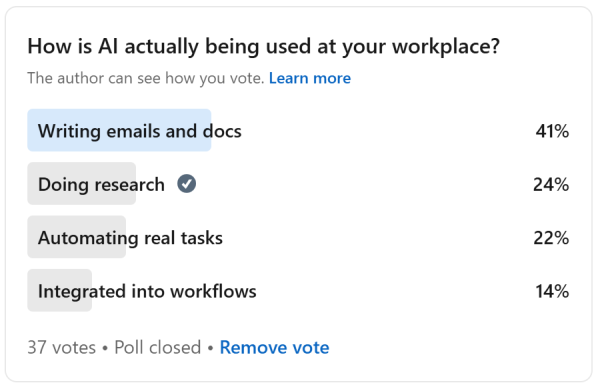
Our recent LinkedIn poll also showed that employees are mostly using AI for basic tasks:
What “AI-ready” employees actually do
AI readiness goes beyond knowing how to enter prompts into ChatGPT. It reflects the ability to work effectively alongside AI to redesign workflows, improve decisions, and unlock creativity. AI-ready employees consistently:
- Automate and streamline routine work while reimagining processes end-to-end
- Apply critical thinking to AI outputs, evaluating their accuracy and relevance
- Seek out and learn new AI tools as technologies evolve
- Influence others by sharing AI knowledge and building trust in new ways of working
When these behaviors are present, organizations report meaningful improvements in productivity, innovation, and employee engagement.
What SHL’s research reveals for HR
A closer look at the data reveals several important patterns.
- Early‑career talent is AI‑native, but not automatically AI‑ready. Graduates are generally comfortable with AI tools and know how to use them but not necessarily in a way that enhances organizational value.
- Experienced professionals often excel in AI literacy and knowledge sharing but can be too cautious. They are more consistent in responsible use and in linking AI to decisions and goals, yet often need support to experiment, rethink workflows and fully reimagine AI‑enabled work.
- Regions and industries differ significantly, with Europe leading on applied AI skills, and sectors such as energy, construction, retail, and healthcare revealing surprising strengths that other industries can learn from.
Taken together, these findings highlight an important message for HR: AI readiness is a capabilities challenge. Readiness cannot be assumed simply because AI tools are available. Organizations need to measure readiness directly and develop it in ways that reflect their specific work contexts.
How to bridge the AI readiness gap
To move beyond broad discussions of AI adoption, SHL developed the AI Readiness model, grounded in SHL’s Universal Competency Framework. This model assesses eight key skills across four core capability areas allowing organizations to measure readiness in a way that is consistent, comparable, and actionable at scale.
This turns “AI readiness” into something you can benchmark, track, and directly link to talent decisions.
With this visibility, organizations can:
- Identify who will embrace and lead with AI: organizations can objectively assess who can apply AI in everyday work, who can innovate with it, and who and champion new AI-powered solutions.
- De-risk transformation: organizations can identify skills gaps in AI-related capabilities, determine who can thrive in reshaped roles, and incorporate AI readiness into skills-based hiring strategies.
- Fuel employee growth and agility: organizations can provide employees with transparent, clear insights and targeted development pathways to build AI skills and confidence in working alongside intelligent systems, rather than fearing its impact.
- Turn AI from disruption into a multiplier: AI will continue to evolve faster than any policy or platform rollout. The role of HR is to ensure that this evolution strengthens human capability rather than overwhelming it.
Watch the full webinar replay to learn more about the research, closing the AI readiness gap, and building AI capability beyond hiring to accelerate AI-enabled performance.
Author